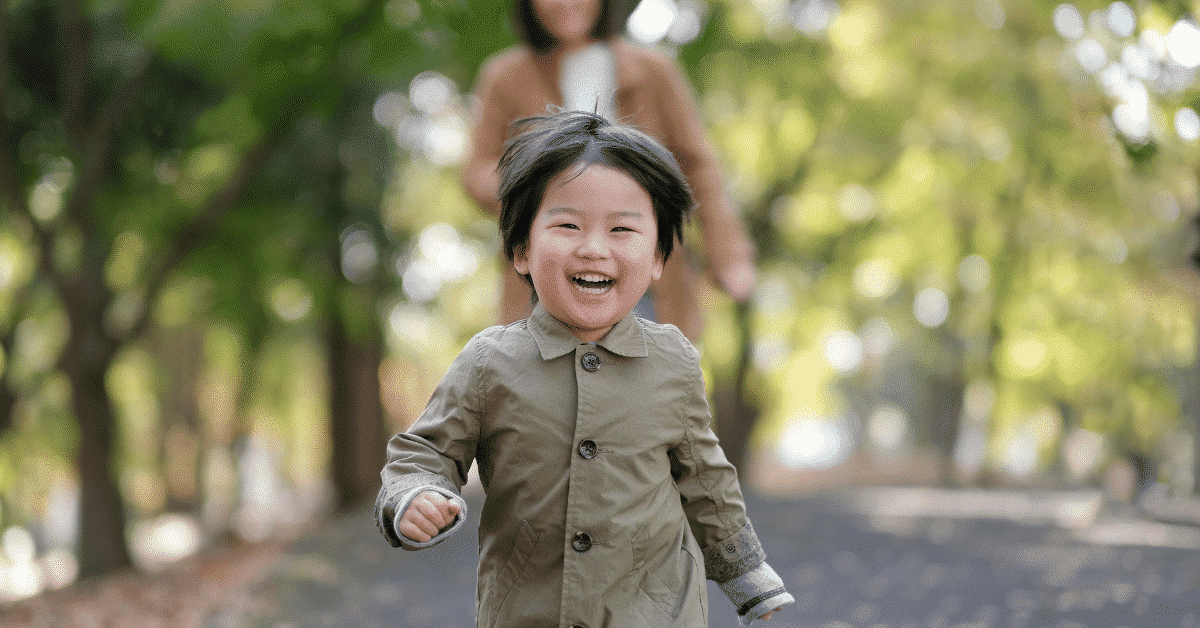
My mum tells this story about how, when I was 18 months old, I climbed to the top of a very tall slide, cunningly waited for her to get to the top of the ladder behind me, shot down the slide, jumped up and sprinted away, cackling and shrieking with laughter at her calls for me to stop.
It took my aunt (who wasn’t struggling down the ladder) running at full pelt to scoop me up just before I launched myself, unknowingly, into the busy road outside the park gates.
I STILL cackle and giggle uncontrollably when being playfully chased, it taps into that toddler joy I continue to carry within me.
My mum probably didn’t enjoy it as much as I did.
Why do toddlers start running away?
When my children were toddlers, I found it hard too. I felt, by turns, frustrated, angry, defeated or exhausted whenever they ran away. It got worse if there were other parents around. I felt their judgment heavily, whether real or imagined.
Society likes parents to look like they are always in control of their children, and when it was obvious my child wasn’t doing what I’d asked them to, I felt so uncomfortable. I found myself parroting common strategies in an attempt to appear like I knew what to do. Like these:
- Explaining, from a distance, why my children should come back. (This repeated reasoning was often unheard or ignored).
- Calling them back in a stern, authoritative voice, counting down from three, and threatening them with a consequence.
- Tempting them with ‘benefits’ if they returned in good time. Yes, I bribed them.
Ultimately, it never ended well. Either my child came back, grumpy and defeated, or I was cross and irritated, completely unable to relax and enjoy my time with my children.
So what IS that childhood need to be chased? Where does it come from? And how can we use it to our advantage?
It wasn’t until later I realised that toddlers have different reasons for running away.
Children develop a sense of autonomy when they are around 18 months. This is when they realise, “I’m me, you’re you.”
Hello, power!
What better way to experience this autonomy, and explore just what a toddler can do, than by running?
But chasing plays into other needs kids have too.
Now, as mother of two, a pre-school childminder, a youth club leader and aunt I have yet to meet a child who doesn’t enjoy being chased.
That’s right. What happens when you play chase? Giggles? Squeals of delight?
This is power at play, plus something else.
When children are being chased by someone they trust they can use the time to play around with fears and anxiety. Master of Playful Parenting, Lawrence J Cohen refers to it as “ScarySafe”.
When a child hits that sweet spot of something feeling scary while also knowing they are safe, they can laugh and giggle and get rid of lighter levels of anxiety and fear. As he says in this article: “Fun, safe and a little scary adventures, just enough to be exciting”, can be helpful in defying fear.” [1]
That’s chase!
And you can play this to your advantage, when you make time to play chase at home, or in a safe space, When you follow your child’s lead, chase can be fantastic for exercising that budding sense of autonomy and power, and helps a child explore feelings of fear and safety.
When your toddler runs away and it feels like defiance
But what about when it doesn’t feel like a game? When children seem to run away in defiance. And what happens when this occurs so often that any outdoor activity feels overshadowed by a sense of threat.
I recently looked after an 18 month old who habitually ran off.
When a child is doing something they are old enough to know not to do and they do it anyway, (especially AFTER being reminded) it’s a clear sign that they could use a little extra connection.
This little one was new to my care, and I took his running away as a sign he needed some warm attention. (Here’s Ten simple ways to connect with your child everyday).[2]
But before I could really do that, I needed to make sure we were all safe.
Plan for your toddler running away
Instead of just hoping it wouldn’t happen, I planned for his running away. I always took a stroller so that if a break was needed, or my attention had to be on another child in my care, I could ensure he was secure.
I visited areas that I was familiar with, and knew had good, heavy gates that would take time for a little one to open, giving me time to reach them if I was occupied with another child.
I only socialized with other childminders who would understand that I couldn’t always chat and would need to follow this child around, without thinking I was being rude or stand-offish, and whom I wouldn’t feel judged by.
And I also got Listening Time about the difficulties of looking after a child that was showing these tricky behaviors. (He had a few other challenging behaviors, alongside the running away).
Prepare how you want to respond
Next I planned what I would do when the toddler was running away.
I kept close, so I could respond fast when he dashed. Using his name, I’d also give a “We need to stay in here” instruction, as I moved towards him.
When I could see that my instruction was ignored, I reminded myself that this wasn’t “naughty” behavior. Instead, it was a sign of his discomfort, anxiety and need for me to be close.”
Quickly, I’d move in and calmly STOP them from moving further away.
When I set a limit, this toddler would often drop to the floor, so I’d place my hand under their head. I didn’t stop them from lying on the floor, or even flinging their head back, but I did make sure they wouldn’t hurt themselves.
And then I listened. Calmly, and with as much understanding as I could manage in the moment.
Crying, anger and frustration would come spilling out.
I murmured my understanding, I offered warm eye contact, soft physical touch.
Just responding to your toddler like this can change the behavior
As this happened, I held in my mind that this gorgeous child had some pretty big upsets that needed to be heard. And that listening would help with his running away, and the other challenging behaviors.
The change was miraculous.
After each outburst, and some days there were several, this toddler could play with greater concentration, and for longer. His affection for me and his delight for life grew. His parents noticed improvements in their toddler’s general behavior and development.
And, by the time this toddler turned two, and I needed to physically prevent them from leaving the playground, they would tell me the reason they were struggling or not feeling good and needed my connection. Looking into his eyes, and seeing that awareness is magical, and something I’ve seen happen again and again with children I’ve listened to like this.
I still needed to be attentive, but not nearly as much. I was able to relax and venture to new, less restrictive parks and playgrounds.
Why is your toddler running away? Think first, then respond.
When you can decode why your toddler is running away, you can decide better how to respond.
Playing chase often gives a child who is exploring the autonomy space they need. It also rewards a child with connection… If they run and laugh, and they look at you, they are looking for your connection.
- Keep things light and playful, and follow Hand in Hand’s directions for Playlistening around chasing with your toddler (below).
- Try to notice how long your child can go without your attention before they act out (by running away). Pre-empt this connection-seeking behaviour by being playful, or connecting with your child.
- Play chase games BEFORE your child has a chance to run away. This also gives you a chance to enjoy the game while you have energy for it. Often, after you and your toddler reconnect through play, they will feel ready to play by themselves and less likely to run off. (If they do, they need a little more connection from you). When a toddler initiates a chase game, I try to meet it with an enthusiastic five minutes of play. After all, five minutes of my time in exchange for a child who is thinking well, and who can be cooperative on our way home is time well spent. I’ve experienced the alternative whining and groaning journey home, and it’s a no-brainer which I prefer.
- You can set limits on your toddler running away playfully. Try scooping your toddler up with a giggle and a playful “Oh no you don’t!”
- Pop them down and let them scamper away again. You can playfully pretend to be confused about where they’ve gone before running and scooping them up again.
- If playful limits don’t work, or you play as much as you can and your toddler still runs away, move in, hold them, or gently prevent them from running away, and listen to whatever frustration or upset follows. Here is a post on setting limits in five words or less. [3]
How to set up a good chase game
Hand in Hand’s approach to play supports toddlers as they work on their autonomy, experience and connection. We call it Playlistening, and it is a powerful tool you can use to help your child work on lifting fears, anxieties or other experiences they want to make sense of. Read more about Playlistening here. [4]
You can play this at home, as you give more opportunities for games like these, or once you have reached a destination, and your child initiates a chase or hide and go seek game.
I make sure that 80% of the time I am, in fact, unsuccessful at either catching or running away from the child or children I’m playing with.
If I’m playing with a non-walker I will crawl VERY slowly, perhaps lunging spectacularly incompetently onto the ground so the child can scamper out of reach.
With a toddler, I still might crawl or stagger slowly.
By the time I’m chasing my eight and ten year olds I might not need to pretend at all, but I will exaggerate my frustration or incredulity at my inability to catch them.
The aim with play like this is to follow your child’s lead. Be careful of adding an adult-initiated element to a game of chase, by for example, adding an unrequested “monster” character to do the chasing. This can be overwhelming, and move the game from easy, safe, connection building, to an anxiety triggering one.
As you play, watch and listen carefully. You know the game is going well when you hear delight, giggles and laughter. But if exuberance turns into a more panicky, shrill laugh, enjoyment can be shifting towards fear and it’s important to pull back.
Just take a breath, and let your child make the next move.
It’s a dance, but as you hear that laughter, you will know that your toddler is doing what they need to – and that you have a way, finally, in letting go of controlling this running, to be in control of it.
Let me know how these ideas go with your toddler. I’d love to hear from you.
Got a potential Usain Bolt on your hands?
Here’s a two-step solution to use if your toddler loves running away.
Step One: Plan
- Connect first! Try some of these games before you leave the house. And you can use some of these games with toddlers while you are out.[5][6]
- When you ARE having a nice time with your toddler, mention it. “Oh, this is nice isn’t it?”
- Suggest a game when you get to your park or playground – and see if your toddler chooses a chase game.
- Stay close enough to reach them before they can reach danger.
- Take a stroller if you know your toddler is prone to running and you need a safe space for them.
Step Two: Respond
- Be ready to move toward your toddler if they run away, rather than use your voice.
- Scoop them up, or playfully set a limit.
- If playful limits aren’t effective, set a limit by gently holding their hands or preventing them from running, and listen. You do not need to say much, and there’s a good guide in What to Say During Staylistening if you are wondering how to do this. [7]
- Be prepared to repeat this for a while if your child has lots to offload.
References
- ^ this article (www.handinhandparenting.org)
- ^ Ten simple ways to connect with your child (www.handinhandparenting.org)
- ^ setting limits in five words or less (www.handinhandparenting.org)
- ^ here. (www.handinhandparenting.org)
- ^ games (www.handinhandparenting.org)
- ^ while you are out (www.handinhandparenting.org)
- ^ What to Say During Staylistening (www.handinhandparenting.org)