Artificial intelligence scares and intrigues us. Almost every week, there’s a new AI scare[1] on the news like developers afraid of what they’ve created or shutting down bots because they got too intelligent. Most of these AI myths[2] result from research misinterpreted by those outside the field. For the fundamentals of AI, feel free to read our comprehensive AI article[3].
The greatest fear about AI is singularity (also called Artificial General Intelligence), a system capable of human-level thinking. According to some experts, singularity also implies machine consciousness. Regardless of whether it is conscious or not, such a machine could continuously improve itself and reach far beyond our capabilities. Even before artificial intelligence was a computer science research topic, science fiction writers like Asimov were concerned about this and were devising mechanisms (i.e. Asimov’s Laws of Robotics) to ensure the benevolence of intelligent machines.
For those who came to get quick answers:
- Will singularity ever happen? According to most AI experts, yes.
- When will the singularity happen? Before the end of the century. The consensus view was that it would take around 50 years in 2010s. After the advancements in Large Language Models (LLMs)[4], a leading AI researcher, Hinton[5], updated his view and believes that it could take 20 years or less.
The more nuanced answers are below. There have been several surveys and research of AI scientists asking about when such developments will take place.
Understand the results of major surveys of AI researchers in 2 minutes
We looked at the results of 5 surveys with around 1700 participants where researchers estimated when singularity would happen. In all cases, the majority of participants expected AI singularity before 2060.
In the 2022 Expert Survey on Progress in AI, conducted[6] with 738 experts who published at the 2021 NIPS and ICML conferences, AI experts estimate that there’s a 50% chance that high-level machine intelligence will occur until 2059.
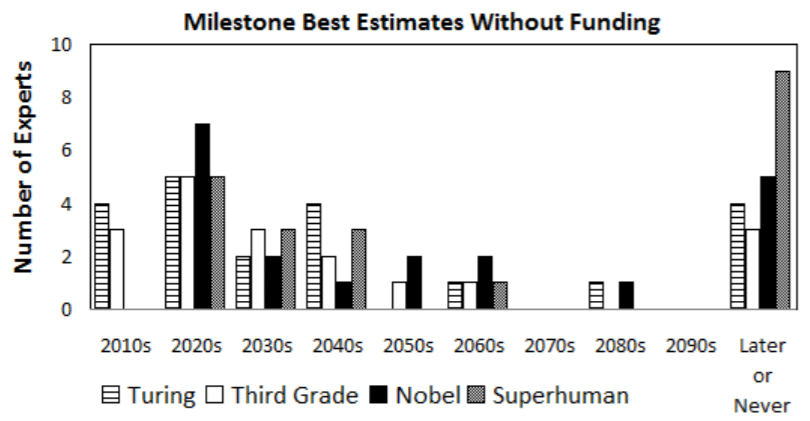
Older surveys had similar conclusions. In 2009, 21 AI experts participating the in AGI-09 conference were surveyed[7]. Experts believed AGI will occur around 2050, and plausibly sooner. You can see above their estimates regarding specific AI achievements: passing the Turing test, passing third grade, accomplishing Nobel worthy scientific breakthroughs and achieving superhuman intelligence.
In 2012/2013, Vincent C. Muller, the president of the European Association for Cognitive Systems, and Nick Bostrom from the University of Oxford, who published over 200 articles on superintelligence and artificial general intelligence (AGI), conducted a survey[8] of AI researchers. 550 participants answered the question: “When is AGI likely to happen?” The answers are distributed as
- 10% of participants think that AGI is likely to happen by 2022
- For 2040, the share is 50%
- 90% of participants think that AGI is likely to happen by 2075.
In 2017 May, 352 AI experts who published at the 2015 NIPS and ICML conferences were surveyed[9]. Based on survey results, experts estimate that there’s a 50% chance that AGI will occur until 2060. However, there’s a significant difference of opinion based on geography: Asian respondents expect AGI in 30 years, whereas North Americans expect it in 74 years. Some significant job functions that are expected to be automated until 2030 are: Call center reps, truck driving, and retail sales.
In 2019, 32 AI experts participated in a survey[10] on AGI timing:
- 45% of respondents predict a date before 2060
- 34% of all participants predicted a date after 2060
- 21% of participants predicted that singularity will never occur.
AI entrepreneurs are also making estimates on when we will reach singularity and they are a bit more optimistic than researchers:
- Louis Rosenberg, computer scientist, entrepreneur, and writer: 2030
- Patrick Winston, MIT professor and director of the MIT Artificial Intelligence Laboratory from 1972 to 1997: He mentioned 2040 while stressing that while it would take place, it is a very hard-to-estimate date.
- Ray Kurzweil, computer scientist, entrepreneur, and writer of 5 national best sellers including The Singularity Is Near: 2045[11][12]
- Jürgen Schmidhuber, co-founder at AI company NNAISENSE and director of the Swiss AI lab IDSIA: ~2050[13]
Keep in mind that AI researchers were over-optimistic before
Examples include:
- AI pioneer Herbert A. Simon[14] in 1965: “machines will be capable, within twenty years, of doing any work a man can do.”
- Japan’s Fifth Generation Computer in 1980 had a ten-year timeline with goals[15] like “carrying on casual conversations”
This historical experience contributes to most current scientists shying away from predicting AGI in bold time frames like 10-20 years. However, just because they are more conservative now doesn’t mean that they are right this time around.
Understand why reaching AGI seems inevitable to most experts
These may seem like wild predictions, but they seem quite reasonable when you consider these facts:
- Human intelligence is fixed unless we somehow merge our cognitive capabilities with machines. Elon Musk’s neural lace startup aims to do this but research on brain-computer interfaces[16] is in the early stages.
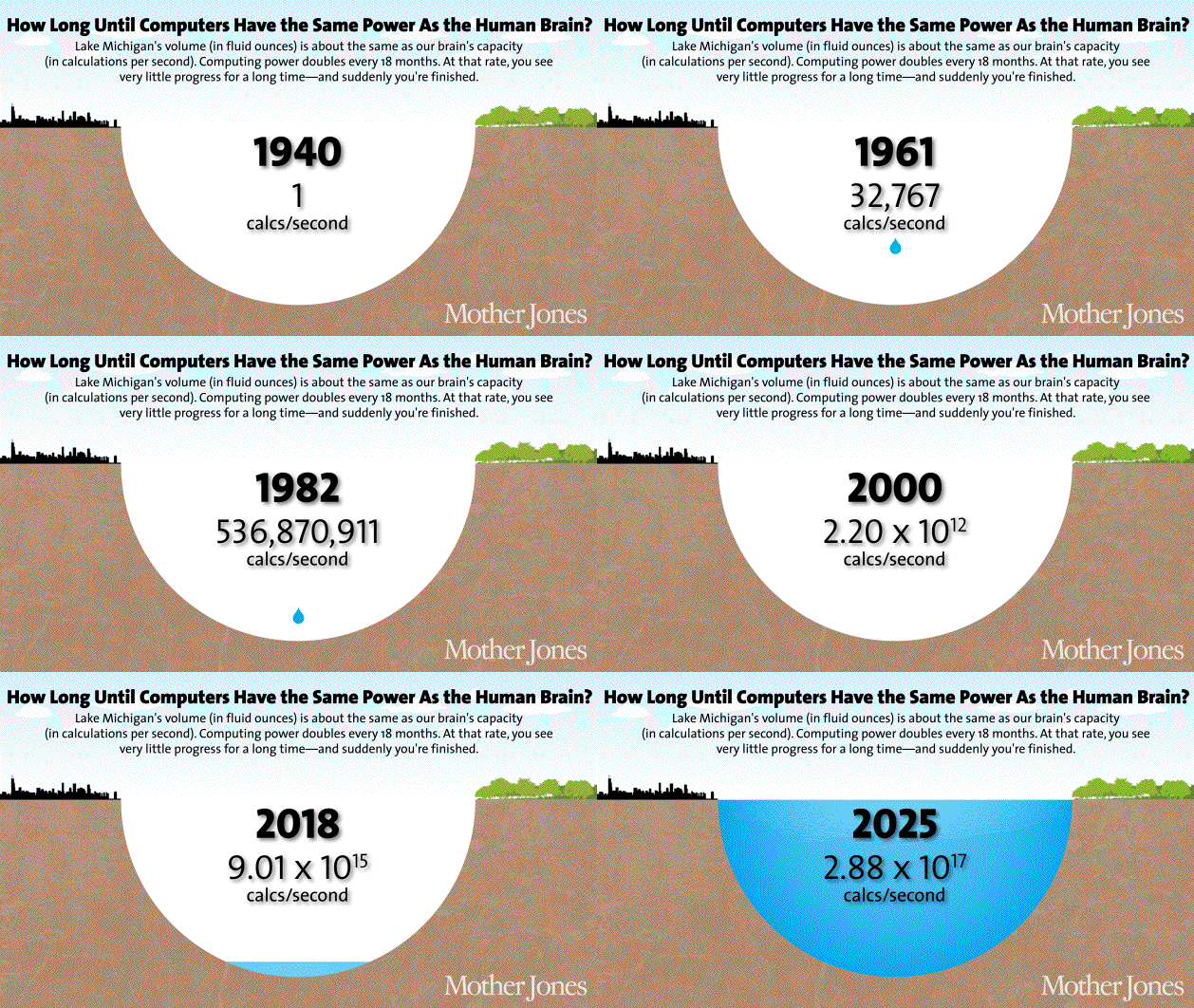
- Machine intelligence depends on algorithms, processing power, and memory. Processing power and memory have been growing at an exponential rate. As for algorithms, until now we have been good at supplying machines with the necessary algorithms to use their processing power and memory effectively.
Considering that our intelligence is fixed and machine intelligence is growing, it is only a matter of time before machines surpass us unless there’s some hard limit to their intelligence. We haven’t encountered such a limit yet.
This is a good analogy for understanding exponential growth. While machines can seem dumb right now, they can grow quite smart, quite soon.
If classic computing slows its growth, quantum computing could complement it
Classic computing has taken us quite far. AI algorithms on classical computers can exceed human performance in specific tasks like playing chess or Go. For example, AlphaGo Zero[17] beat AlphaGo by 100-0. AlphaGo had beaten the best players on earth. However, we are approaching the limits of how fast classical computers can be.
Moore’s law, which is based on the observation that the number of transistors in a dense integrated circuit double about every two years, implies that the cost of computing halves approximately every 2 years. However, most experts believe that Moore’s law is coming to an end[18] during this decade. Though there are efforts to keep improving application performance[19], it will be challenging to keep the same rates of growth.
Quantum Computing[20], which is still an emerging technology, can contribute to reducing computing costs after Moore’s law comes to an end. Quantum Computing is based on the evaluation of different states at the same time whereas classical computers can calculate one state at one time. The unique nature of quantum computing can be used to efficiently train neural networks, currently the most popular AI architecture in commercial applications. AI algorithms running on stable quantum computers have a chance to unlock singularity.
For more information about quantum computers feel free to read our articles on quantum computing[21].
Understand why some believe that we will not reach AGI
There are 3 major arguments against the importance or existence of AGI. We examined them along with their common rebuttals:
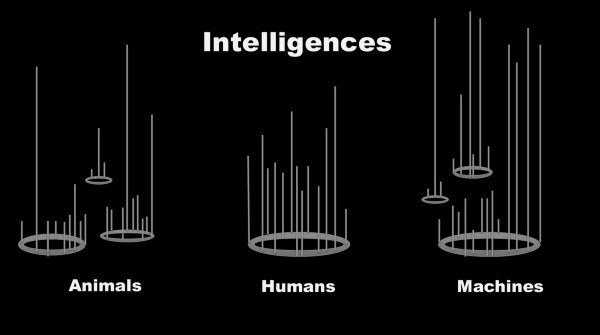
1- Intelligence is multi-dimensional
Therefore, AGI will be different, not superior to human intelligence.
- This is true and human intelligence is also different than animal intelligence. Some animals are capable of amazing mental feats like squirrels remembering where they hid hundreds of nuts for months.
- Yann LeCun[22], one of the pioneers of deep learning, believes that we should retire the word AGI and focus on achieving “human-level AI”.
- In areas where machines exhibited super-human intelligence, humans were able to beat them by leveraging machine-specific weaknesses. For example, in 2023 an amateur was able to beat a go program[23] that is on par with go programs that beat world champions[24] by studying and leveraging the program’s weaknesses.
However, these differences do not stop humans from achieving far more than other species in terms of many typical measures of success for a species. For example, homo sapiens is the species that contribute most[25] to the bio-mass on the globe among mammals.
2- Intelligence is not the solution to all problems
For example, even the best machine analyzing existing data will probably not be able to find a cure for cancer. It will need to run experiments and analyze results to discover new knowledge in most areas.
This is true with some caveats. More intelligence can lead to better-designed and managed experiments, enabling more discovery per experiment. History of research productivity should probably demonstrate this but data is quite noisy and there are diminishing returns on research. We encounter harder problems like quantum physics as we solve simpler problems like Newtonian motion.
3- AGI is not possible because it is not possible to model the human brain
Theoretically, it is possible to model any computational machine including the human brain with a relatively simple machine that can perform basic computations and has access to infinite memory and time. This is the Church-Turing hypothesis laid out in 1950. It is universally accepted. However as stated, it requires certain difficult conditions: infinite time and memory.
Most computer scientists believe that it will take less than infinite time and memory to model the human brain. However, there is not a mathematically sound way to prove this belief as we do not understand the brain enough to exactly understand its computational power. We will just have to build such a machine!
And we haven’t been successful, yet. For example, the ChatGPT large language model[26] launched in November/2022 caused significant excitement with its fluency and quickly reached a million users. However, its lack of logical understanding makes its output error-prone. For a more dramatic example, this is a video[27] of what happens when machines play soccer. It is a bit dated (from 2017) but makes even me feel like a soccer legend in comparison.
To learn more about Artificial General Intelligence
Ray Kurzweil[28]’s lecture:
Joshua Brett Tenenbaum[29], a Professor of Cognitive Science and Computation at MIT, is explaining how we can achieve AGI singularity:
Hope this clarifies some of the major points regarding AGI. For more on how AI is changing the world, you can check out articles on AI, AI technologies[30] and AI applications in marketing[31], sales[32], customer service[33], IT, data[34] or analytics[35].
And if you have a business problem that is not addressed here:
Find the Right Vendors[36]External links
Source: Arguments against AGI based partially on Wired’s summary[37] of arguments against AGI and Wikipedia
References
- ^ scare (www.vox.com)
- ^ AI myths (research.aimultiple.com)
- ^ feel free to read our comprehensive AI article (research.aimultiple.com)
- ^ Large Language Models (LLMs) (research.aimultiple.com)
- ^ Hinton (www.cbsnews.com)
- ^ conducted (aiimpacts.org)
- ^ surveyed (sethbaum.com)
- ^ survey (nickbostrom.com)
- ^ surveyed (arxiv.org)
- ^ survey (emerj.com)
- ^ The Singularity Is Near (www.amazon.com)
- ^ 2045 (futurism.com)
- ^ 2050 (futurism.com)
- ^ Herbert A. Simon (en.wikipedia.org)
- ^ goals (en.wikipedia.org)
- ^ brain-computer interfaces (en.wikipedia.org)
- ^ AlphaGo Zero (en.wikipedia.org)
- ^ end (en.wikipedia.org)
- ^ application performance (rebootingcomputing.ieee.org)
- ^ Quantum Computing (research.aimultiple.com)
- ^ quantum computers feel free to read our articles on quantum computing (research.aimultiple.com)
- ^ Yann LeCun (en.wikipedia.org)
- ^ beat a go program (research.aimultiple.com)
- ^ beat world champions (research.aimultiple.com)
- ^ most (www.pnas.org)
- ^ ChatGPT large language model (research.aimultiple.com)
- ^ video (twitter.com)
- ^ Ray Kurzweil (en.wikipedia.org)
- ^ Joshua Brett Tenenbaum (en.wikipedia.org)
- ^ AI technologies (research.aimultiple.com)
- ^ marketing (research.aimultiple.com)
- ^ sales (research.aimultiple.com)
- ^ customer service (research.aimultiple.com)
- ^ data (research.aimultiple.com)
- ^ analytics (research.aimultiple.com)
- ^ Find the Right Vendors (aimultiple.com)
- ^ summary (www.wired.com)