It’s now widely agreed (even by Britain, finally[1]) that every country needs to “flatten the curve”: impose social distancing[2] to slow the spread of the virus so that the number of people sick at once doesn’t cause the health-care system to collapse, as it is threatening to do in Italy right now. That means the pandemic needs to last, at a low level, until either enough people have had Covid-19 to leave most immune (assuming immunity lasts for years, which we don’t know[3]) or there’s a vaccine.
How long would that take, and how draconian do social restrictions need to be? Yesterday President Donald Trump, announcing new guidelines such as a 10-person limit on gatherings, said that “with several weeks of focused action, we can turn the corner and turn it quickly.” In China, six weeks of lockdown are beginning to ease[4] now that new cases have fallen to a trickle.
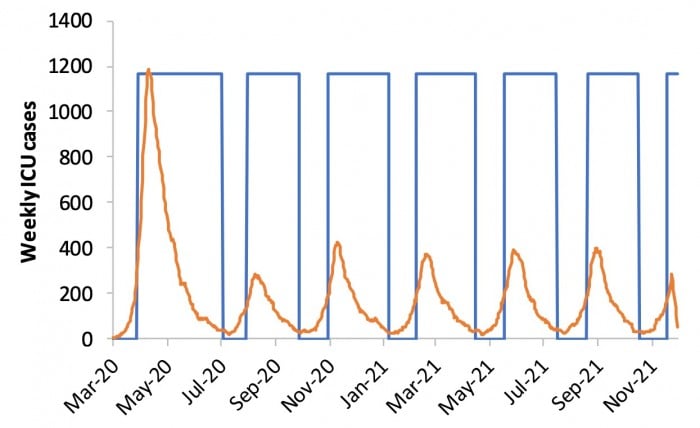
But it won’t end there. As long as someone in the world has the virus, breakouts can and will keep recurring without stringent controls to contain them. In a report yesterday[5] (pdf), researchers at Imperial College London proposed a way of doing this: impose more extreme social distancing measures every time admissions to intensive care units (ICUs) start to spike, and relax them each time admissions fall. Here’s how that looks in a graph.
Imperial College Covid-19 Response Team.
The orange line is ICU admissions. Each time they rise above a threshold—say, 100 per week—the country would close all schools and most universities and adopt social distancing. When they drop below 50, those measures would be lifted, but people with symptoms or whose family members have symptoms would still be confined at home.
What counts as “social distancing”? The researchers define it as “All households reduce contact outside household, school or workplace by 75%.” That doesn’t mean you get to go out with your friends once a week instead of four times. It means everyone does everything they can to minimize social contact, and overall, the number of contacts falls by 75%.
Under this model, the researchers conclude, social distancing and school closures would need to be in force some two-thirds of the time—roughly two months on and one month off—until a vaccine is available, which will take at least 18 months (if it works at all[6]). They note that the results are “qualitatively similar for the US.”
Eighteen months!? Surely there must be other solutions. Why not just build more ICUs and treat more people at once, for example?
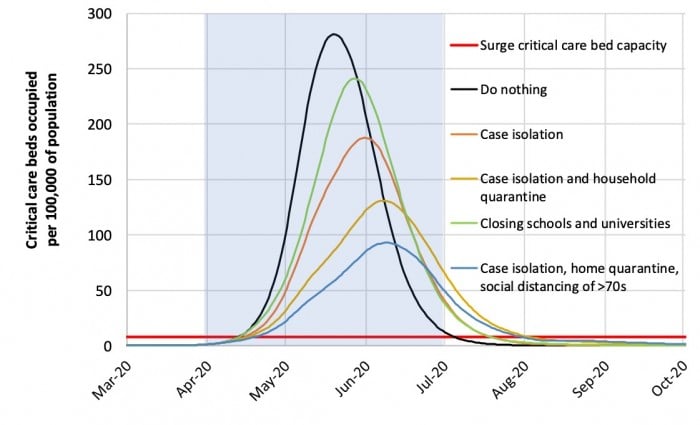
Well, in the researchers’ model, that didn’t solve the problem. Without social distancing of the whole population, they found, even the best mitigation strategy—which means isolation or quarantine of the sick, the old, and those who have been exposed, plus school closures—would still lead to a surge of critically ill people eight times bigger than the US or UK system can cope with. (That’s the lowest, blue curve in the graph below; the flat red line is the current number of ICU beds.) Even if you set factories to churn out beds and ventilators and all the other facilities and supplies, you’d still need far more nurses and doctors to take care of everyone.
Imperial College Covid-19 Response Team
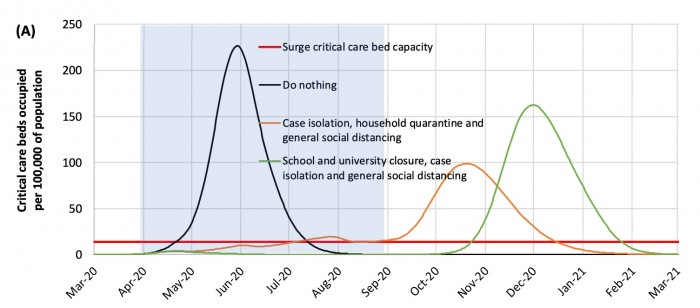
How about imposing restrictions for just one batch of five months or so? No good—once measures are lifted, the pandemic breaks out all over again, only this time it’s in winter, the worst time for overstretched health-care systems.
Imperial College Covid-19 Response Team.
And what if we decided to be brutal: set the threshold number of ICU admissions for triggering social distancing much higher, accepting that many more patients would die? Turns out it makes little difference. Even in the least restrictive of the Imperial College scenarios, we’re shut in more than half the time.
This isn’t a temporary disruption. It’s the start of a completely different way of life.
Living in a state of pandemic
In the short term, this will be hugely damaging to businesses that rely on people coming together in large numbers: restaurants, cafes, bars, nightclubs, gyms, hotels, theaters, cinemas, art galleries, shopping malls, craft fairs, museums, musicians and other performers, sporting venues (and sports teams), conference venues (and conference producers), cruise lines, airlines, public transportation, private schools, day-care centers. That’s to say nothing of the stresses on parents thrust into home-schooling their kids, people trying to care for elderly relatives without exposing them to the virus, people trapped in abusive relationships, and anyone without a financial cushion to deal with swings in income.
References
- ^ even by Britain, finally (www.technologyreview.com)
- ^ social distancing (www.technologyreview.com)
- ^ we don’t know (www.theatlantic.com)
- ^ are beginning to ease (www.washingtonpost.com)
- ^ report yesterday (www.imperial.ac.uk)
- ^ works at all (www.technologyreview.com)